

VIP System
High Rakeback
Zero-edge originals
Dice guide · zero edge · provably fair

Game mechanics, RTP range, and volatility.
Zero edge selection
Maximize your winning potential by choosing games with 100% RTP
Test without risk
The Dice demo lets you test the Over/Under mechanic, explore different win probability targets, and understand how multipliers change before playing with real money.
Origins · mechanics · math
From ancient bone dice to a 100-sided virtual die with provably fair verification
Crypto Dice is not about rolling a pair of physical dice and hoping for a specific number. It is a digital prediction game built around a virtual 100-sided die. The player sets a target number and bets on whether the result of a random roll will be higher or lower than that target. The closer the target is to the extremes, the higher the multiplier - but the lower the probability of winning.
This format became one of the very first casino games in the cryptocurrency space. Platforms like SatoshiDice (launched in 2012) and Primedice pioneered the concept, proving that a simple number-guessing mechanic could sustain an entire gambling ecosystem. The transparency of the blockchain made provably fair verification possible, and Dice became the poster child for crypto gambling.
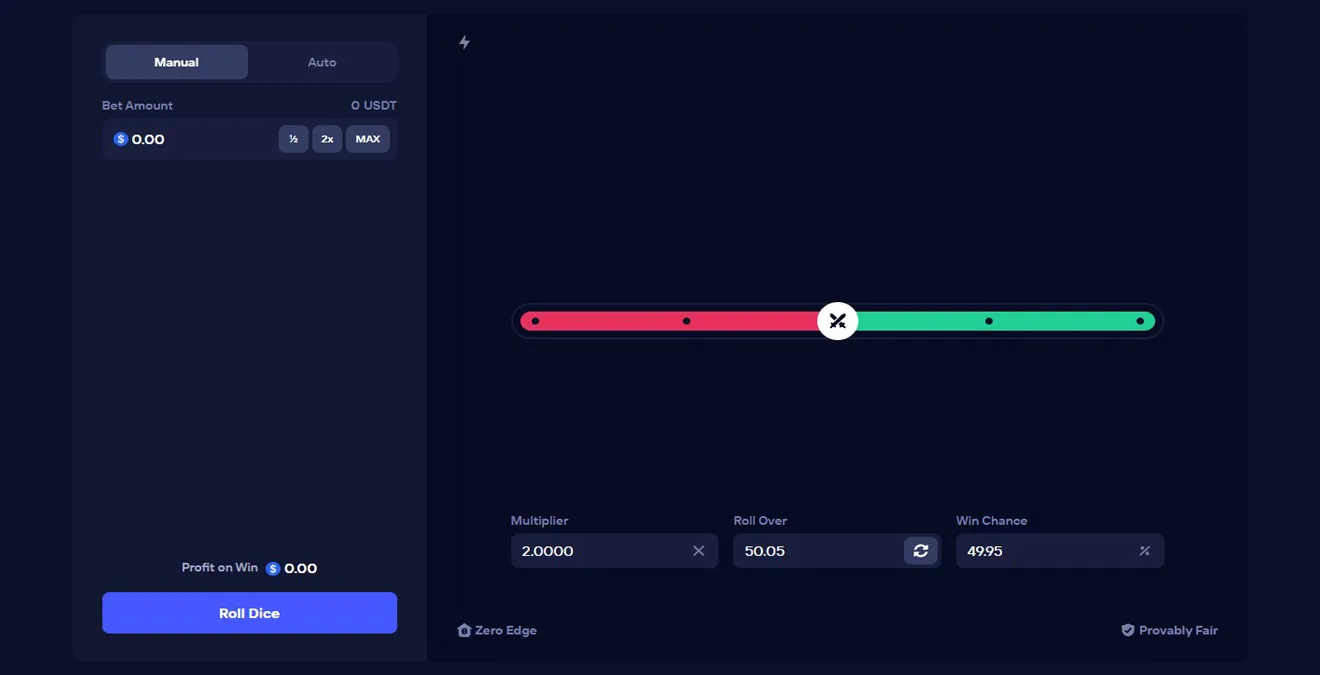
At its core, every Dice game works the same way. A random number between 0 and 99.99 is generated. The player chooses a target threshold and bets on one of two outcomes: Roll Over (the result is higher than the target) or Roll Under (the result is lower). The distance between the target and the edge of the range determines both the win probability and the multiplier.
Most modern Dice games include a probability slider that lets you adjust the target in real time. Slide to the left, and you increase win probability but lower the multiplier. Slide to the right, and you chase a rarer outcome with a bigger payout. The formula behind this is clean and transparent: Multiplier = (100 - House Edge) / Win Probability. At 100% RTP, the formula simplifies to Multiplier = 100 / Win Probability.
This mathematical clarity is what sets Dice apart from most casino games. There are no hidden paylines, no bonus wheel mysteries, and no opaque RNG configurations. The player sees the exact probability, the exact multiplier, and can verify every roll through provably fair seeds.
Dice succeeded in crypto casinos for three reasons: simplicity, speed, and transparency. A single round takes less than a second. The math is visible and verifiable. And the player has complete control over their risk-reward ratio through a single slider.
Over time, Dice expanded from a niche crypto game into a format offered by virtually every major platform. Stake, BC.Game, Gamdom, Duel, and dozens of others all have their own Dice implementations. While the visual design varies, the core mechanic remains identical: pick a number, place a bet, and let the RNG decide.
The enduring popularity of Dice also comes from its appeal to systematic players. Because the math is fully transparent, strategies like Martingale, Anti-Martingale, and Paroli systems can be applied with precision. Whether those strategies improve outcomes over the long run is debatable, but they add a layer of structure and control that many players find satisfying.
Today, the Dice category includes more than just the classic Over/Under format. Evolution offers live dealer versions like Lightning Dice and Super Sic Bo, which blend physical dice with digital multipliers. BGaming created Dice Clash, a PvE format where the player's roll competes against a dealer's roll.
On the crypto side, the Over/Under format remains dominant. Gamdom Dice and Duel Dice both offer 100% RTP configurations, where the multiplier formula has no built-in margin. These versions represent the purest form of the game: a number, a threshold, and a perfectly fair payout structure.
The key differences between Dice versions come down to RTP, max multiplier, speed of play, auto-bet features, and whether the game supports provably fair verification. For players who care about mathematical transparency, the crypto Originals remain unmatched.
Game psychology
The appeal of controlling your own probability
Dice offers something that most casino games cannot: the feeling of genuine control over risk. The probability slider is not just a UI element - it is a decision tool that directly translates the player's risk appetite into a mathematical outcome. Set 50% and you get a coin flip with a 2x payout. Set 1% and you enter lottery territory at 99x.
This sense of agency is what makes Dice so addictive for analytical players. Every bet is a conscious trade-off between safety and reward. There are no hidden surprises, no mystery reels, and no bonus triggers to wait for. The entire game is compressed into a single, clean decision point.
The speed factor adds another dimension. Dice rounds complete in milliseconds, and auto-bet features allow hundreds of bets per minute. This rapid cycle of risk-decision-outcome creates a feedback loop that keeps players engaged far longer than the simplicity of the game might suggest.
A clear comparison of Dice games from major providers and casino originals, covering RTP, multiplier range, mechanic type, and provably fair status.
| Game | Provider | RTP | Max Multiplier | Mechanic | Provably Fair |
|---|---|---|---|---|---|
| Dice | Stake Original | 99% | 9,900x | Over/Under 100-side | Yes |
| Primedice | Stake | 99% | 9,900x | Over/Under + ranges | Yes |
| Dice | BC.Game Original | 99% | 9,900x | Over/Under 100-side | Yes |
| Dice Clash | BGaming | 98.05% | 46x | Dice comparison PvE | No |
| Lightning Dice | Evolution | 96.21% | 1,000x | Live dealer 3 dice | No |
| Super Sic Bo | Evolution | 97.22% | 1,000x | Live 3 dice + multipliers | No |
| Craps Live | Evolution | 83-99% | 150x | Live craps table | No |
| Gamdom Dice | Gamdom Original | 100% | 9,900x | Over/Under 100-side | Yes |
| Duel Dice | Duel Original | 100% | 9,900x | Over/Under 100-side | Yes |
Math & zero edge
How Duel and Gamdom removed the casino edge from their Dice originals.
In a standard Dice game with 99% RTP, the multiplier formula is Multiplier = 99 / Win Probability. That 1% gap is the house edge - over millions of rolls, the casino keeps that fraction of every bet as profit. The player sees the probability slider, the multiplier, and everything looks transparent. But the math quietly skims 1% off every outcome.
A 100% RTP version changes the formula to Multiplier = 100 / Win Probability. The long-term expected return equals exactly the amount bet. There is no margin, no hidden fee, and no mathematical advantage for the operator. A 50% win chance pays exactly 2x. A 10% chance pays exactly 10x. A 1% chance pays exactly 100x.
At Duel Casino, Dice is part of their zero-edge Originals lineup with full provably fair verification. The multiplier table follows the exact mathematical formula with no deductions.
Gamdom builds their Dice with 99% RTP in the base math and returns the remaining 1% through their rakeback system. For active players, the effective RTP reaches 100% - though the return mechanism is indirect rather than built into the multiplier formula itself.
In 100% RTP Dice, the multiplier tells the exact truth. Win probability times multiplier equals exactly 100%. Nothing taken, nothing hidden.
Important about zero edge
100% RTP is not a guarantee of winning
Explore other original formats where operators offer zero-edge or max-RTP configurations.







Gameplay & discipline
The math is transparent. The only variable left is how you manage your bets, your targets, and your bankroll.
Dice is one of the most mathematically transparent casino games: choose a target, predict the outcome, and collect if you are right. Every element of risk is visible before you place the bet.
Choose a stake that fits your session bankroll. Dice rounds are instant, so smaller bets allow for more rolls and better variance management.
Decide whether you are betting the result will be above or below your target number. Both directions work identically - only the threshold position changes.
Move the slider to set your win probability and corresponding multiplier. Higher probability means smaller payouts; lower probability means bigger risk and bigger rewards.
Click to roll. The RNG generates a number between 0 and 99.99, and the result is compared to your target instantly.
Track your results over time. Avoid chasing losses by jumping to low-probability targets. Stick to your pre-set limits and exit strategy.
The table below shows the exact multiplier for each win probability level. At 100% RTP, the formula is simple: Multiplier = 100 / Win Chance (%). The lower your target probability, the higher the reward - but the rarer the hit.
A 50/50 bet at 2x multiplier is the best way to understand how Dice variance feels. Track your results over 100 rolls before adjusting.
Keep your bet size constant. Avoid the temptation to increase stakes after a win or loss - emotional betting is the fastest way to drain a bankroll.
Martingale (doubling after loss) looks attractive in theory but requires exponentially growing bets. Five losses in a row on a 50% chance means a 32x bet to recover - and that scenario happens more often than you think.
Define your loss limit and profit target before rolling. Dice rounds are instant and addictive - without boundaries, sessions can spiral quickly.
Auto-bet features can execute hundreds of rolls per minute. Always set stop-loss and stop-profit limits when using automation.
After a losing streak, switching to a 5% or 1% target to "win it all back" almost always makes things worse. The game has no memory - each roll is independent.
Psychology of the game
Not just about the roll. Dice works on the level of mathematical transparency, speed, and the illusion of control.
Every parameter is visible: win probability, multiplier, house edge. There are no hidden mechanics or surprise outcomes - just clean, verifiable math in every bet.
A Dice roll takes milliseconds. There is no animation delay, no bonus loading, and no waiting. This speed creates a uniquely addictive feedback loop for action-oriented players.
The probability slider puts the entire risk spectrum in the player's hands. From near-certain small wins to lottery-tier moonshots, every position on the slider is a conscious choice.

Answers that matter
The most common questions about Dice mechanics, RTP, probability, and choosing the right version.
Dice is a crypto casino game built around a virtual 100-sided die. You set a target number and predict whether the roll lands over or under it. The probability slider lets you choose your exact win chance from roughly 2% to 98%, and the payout multiplier adjusts automatically using the formula: multiplier equals 100 divided by your win probability. Every roll is provably fair.
Duel and Gamdom both offer Dice at a full 100% RTP with zero house edge. Most crypto casinos run Dice at 97-99% RTP, meaning the house keeps 1-3% of every wager. At 100% RTP the expected return equals exactly what you bet.
The slider sets your win chance. A 50% win chance gives a 2x multiplier. A 10% win chance gives 10x. A 95% win chance gives roughly 1.05x. The relationship is inverse and mathematically transparent. You always know your exact odds and payout before clicking roll.
Flat betting at 45-55% win chance is the safest approach for learning. Martingale doubles after each loss to recover, but requires deep bankroll and has risk of ruin. Target-based strategies set a profit goal and stop. At 100% RTP no strategy has a mathematical edge or disadvantage, so it comes down to variance management.
Auto-bet lets you configure a roll sequence that runs automatically. You set your bet amount, win chance, and rules for what happens on win or loss, such as increasing or resetting the bet. This allows hundreds of rolls per minute, which is useful for executing strategies like Martingale at speed.
SatoshiDice launched in 2012 as one of the first Bitcoin gambling games ever created. It introduced the over/under prediction mechanic and provably fair verification. Primedice followed in 2013 and added the probability slider that became standard. Nearly every crypto casino now offers some version of the format.
Yes. Both Duel and Gamdom use cryptographic seed pairs for every roll. After each bet you can reveal the server seed and combine it with your client seed and nonce to independently recalculate the result. This proves the outcome was locked before you placed your bet.